If you've read MyPaper , you would have realised the following story: Dream $110k wedding ends in debt.
People say wedding is a once in a lifetime event so its a lot of young couples dream to have a grand wedding. Or is it more about face, pride and ego where the more money you spend on your wedding, the greater pride you have?
No doubt our society has changed where we always want to have better material posessions than others. Better clothes, better phones, better houses, better cars and better weddings. Often, all these materialism seeking ends up in trouble for individuals as well as couples.
This particular couple spent $110k on their wedding. The result? The couple is still in debt since their wedding in October 2012. They lost sleep for many months as debtors keep hounding them to repay their debts. They live month to month just to meet ends meet. The wife suffered from depression six months after their wedding and quit her job. Is this all worth it?
This is a classic example of overleveraging on debt. Let me show you what debt they took just to have this grand wedding.
1) Borrowed $45,000 from a financial institution with a repayment period of 2 years
2) Borrowed $4000 from a licensed moneylender.
3) Borrowed $11,000 from a relative
4) Charged $30,000 to their individual credit cards
5) Emptied savings of $20,000
This couple accumulated a debt of $90,000. I do not know how much salary they get per month. It was only stated that the both the couple were insurance agents. They must have thought they could repay the debt easily by working harder and making more sales. It looks like the sales didn't come in the end.
This is a timely reminder for us that we should not over leverage on debt. Don't be too confident that your income will always be there. Even with a stable job, there will always be the possibility of retrenchment.
This couple greatly regretted their choice they made to borrow just to have a grand wedding. They have had more fights and quarrels after they got married more than the 6 years that they were dating.
Buying a house? Buying a car? Planning for a wedding? It is always wise not to overstretch yourself on debt. Always have extra savings in the form of an emergency fund so that when crisis strikes, you'll be able to live through it.
Read the full story here: http://news.asiaone.com/news/diva/dream-110k-wedding-ends-debt
Like my articles?
You can Subscribe to SG Young Investment by Email
or follow me on my Facebook page
Monday, 6 January 2014
Sunday, 5 January 2014
The fall of Lehman Brothers
Lehman Brothers was one of the oldest investment bank on Wall St. Now, we know that this big bank has become a history. How did the bankruptcy of one bank lead to one of the greatest financial crisis in the world? If you did not know, the 2008 global financial crisis was said to be the 2nd worst financial crisis in the world just after the famous great depression. The crisis was so bad that US had to embark on QE from then till now. Billions of dollars have already been injected into the economy to stabilise it.
One of the main reason for the crisis is greed and the love of money. Watch the following documentary on the fall of Lehman Brothers to find out more:
Wednesday, 1 January 2014
New year resolutions and investment strategies for 2014
A new year a new beginning. Its the first day of 2014. Everyone would be busy at work, school etc. I took leave on this first day to really think and pen my thoughts down for the new year ahead.
I will also be penning down some investment strategies that I would be embarking on for this year.
New year resolutions for 2014
1) Full time Work
I've been in my current company for 3 years and 3 months. Even though I'll be switching career sometime in the near future, I feel that I should still use my time in my current company to learn and contribute as much as I can. I hope to increase my communication skills and interact with more top level management in my company and also my vendors and contractors. This would enhance even my email writing skills to write in a professional manner.
There will definitely be more projects that I'll be tasked to take this year. I've been given ample opportunities by my managers and director to perform in the company. I hope to deliver my work in quality as what I've always done. There's always a tenancy to be complacent and errors could be made in the process. Its good to maintain a habit to check, double check and triple check.
2) Part time studies
I'm left with only 8 months to graduation. I hope to maintain my above average results and continue to study hard for all my exams. I'll be taking advance macroeconomics for my next semester and it's expected to be a tough module. I'll have to widen my reading outside pf textbook as this module is famous for asking outside textbook questions for the exam.
3) Getting out of my comfort zone
This is a year where I'll be making a very major decision. After I graduate, I'll be sourcing for career opportunities related to my degree. I hope to get into a career related to economics or finance. I've been looking out for possible jobs available since last year. I'll start preparing and apply for those jobs once I graduate. I should also brush up on my interview skills.
4) Health
I feel that having a habit of exercising is important. Jogging is a basic form of exercising. I hope to maintain the habit of jogging at least once a week. Also, eating habits are important too. Eating less oily and fried food will be beneficial in the long run.
5) Family and Friends
This is something we have to constantly remind ourselves to cater time for those people we love. In the midst of my busyness, i will still cater time for my friends and family members.
6) Financial Goals
My goal is to save up an extra capital of 22k for the year 2014. Investment wise, i hope to achieve a passive income from dividends of $1500 for this year. This would mean a stock portfolio of about $30k. I'll elaborate more on my strategies below.
Investment strategies for 2014
The Singapore market has been relatively flat for the year of 2013. Money has been flowing back to the US and Europe region as their economy slowly recovers. Singapore's economy has been stagnant also thus reflecting it in the stock market. Even though Singapore's stock market may be flat, there are some companies which will still benefit from the economic recovery elsewhere.
Focus area for 2014
I'll be cautious on Singapore's property market and stocks that deal with properties This includes REITS which have huge exposure to Singapore's property market. My focus area will be on the shipping, construction and healthcare sector this year. I've wrote on the shipping sector extensively in my previous few blog posts. They are set to benefit from the improved global economic conditions as demand for goods goes up. Dry bulk shipping stocks have more than doubled in the year 2013 while Singapore shipping stocks are still lagging behind.
Construction sector is the next big thing in Singapore. With plans for the new MRT lines, expansion of our existing expressways, plans to build the new Changi Airport terminal 4 and the iconic building Jewel @ Changi, new marina bay CBD. You can see many huge projects are in place.
Healthcare sector is a new focus i have. I'll be researching on more healthcare related stocks and see which ones are suitable for investing for this year. Singapore has an ageing population and people need more of these services. Parkway life Reit has some of the top private hospitals in Singapore. This include Mount Elizabeth hospital and Gleneagles hospital. I'll be watching closely on this and accumulate when the price is right.
I'm also planning to add telecom related stocks to my portfolio. Having been in this industry for the past 3 years, i've the chance to deal with most of the telecommunication companies in Singapore. This gave me a chance to understand the business model and the prospects it has. The telecommunication industry is a stable industry and will be a good investment for income. Their profits have been rather consistent with very minimal risk.
The Japanese economy is of interest to me. I've allocate a portion of my capital for investing into Japanese related stocks believing that their economy will recover as the Yen falls and exports increases. As Japan gets out of its deflationary economy, prices will stop dropping and even start to rise. Their property market will surely benefit from this change. Croesus retail trust and Saizen reit both own significant numbers of properties in Japan. Rental income will also set to rise for these 2 trust. I feel they are a good investment to take advantage of the Japan's economic recovery and also a good investment for income.
I'll be mixing my portfolio with growth and high yield stocks. One is for capital appreciation while the other is for income. I'll also still be trading some stocks for the short term while focusing on long term investment. A portion of my capital is allocated to my CFD account for short term trading. The profits gained from this trading account will be channelled back to my investment account for buying good companies.
This is my focus for the time being. As the year goes along, situation might change. Till then, i'll change and plan accordingly.
Here's wishing you success to your life and investments for the year of 2014.
Like my articles?
You can Subscribe to SG Young Investment by Email
or follow me on my Facebook page
I will also be penning down some investment strategies that I would be embarking on for this year.
New year resolutions for 2014
1) Full time Work
I've been in my current company for 3 years and 3 months. Even though I'll be switching career sometime in the near future, I feel that I should still use my time in my current company to learn and contribute as much as I can. I hope to increase my communication skills and interact with more top level management in my company and also my vendors and contractors. This would enhance even my email writing skills to write in a professional manner.
There will definitely be more projects that I'll be tasked to take this year. I've been given ample opportunities by my managers and director to perform in the company. I hope to deliver my work in quality as what I've always done. There's always a tenancy to be complacent and errors could be made in the process. Its good to maintain a habit to check, double check and triple check.
2) Part time studies
I'm left with only 8 months to graduation. I hope to maintain my above average results and continue to study hard for all my exams. I'll be taking advance macroeconomics for my next semester and it's expected to be a tough module. I'll have to widen my reading outside pf textbook as this module is famous for asking outside textbook questions for the exam.
3) Getting out of my comfort zone
This is a year where I'll be making a very major decision. After I graduate, I'll be sourcing for career opportunities related to my degree. I hope to get into a career related to economics or finance. I've been looking out for possible jobs available since last year. I'll start preparing and apply for those jobs once I graduate. I should also brush up on my interview skills.
4) Health
I feel that having a habit of exercising is important. Jogging is a basic form of exercising. I hope to maintain the habit of jogging at least once a week. Also, eating habits are important too. Eating less oily and fried food will be beneficial in the long run.
5) Family and Friends
This is something we have to constantly remind ourselves to cater time for those people we love. In the midst of my busyness, i will still cater time for my friends and family members.
6) Financial Goals
My goal is to save up an extra capital of 22k for the year 2014. Investment wise, i hope to achieve a passive income from dividends of $1500 for this year. This would mean a stock portfolio of about $30k. I'll elaborate more on my strategies below.
Investment strategies for 2014
The Singapore market has been relatively flat for the year of 2013. Money has been flowing back to the US and Europe region as their economy slowly recovers. Singapore's economy has been stagnant also thus reflecting it in the stock market. Even though Singapore's stock market may be flat, there are some companies which will still benefit from the economic recovery elsewhere.
Focus area for 2014
I'll be cautious on Singapore's property market and stocks that deal with properties This includes REITS which have huge exposure to Singapore's property market. My focus area will be on the shipping, construction and healthcare sector this year. I've wrote on the shipping sector extensively in my previous few blog posts. They are set to benefit from the improved global economic conditions as demand for goods goes up. Dry bulk shipping stocks have more than doubled in the year 2013 while Singapore shipping stocks are still lagging behind.
Construction sector is the next big thing in Singapore. With plans for the new MRT lines, expansion of our existing expressways, plans to build the new Changi Airport terminal 4 and the iconic building Jewel @ Changi, new marina bay CBD. You can see many huge projects are in place.
Healthcare sector is a new focus i have. I'll be researching on more healthcare related stocks and see which ones are suitable for investing for this year. Singapore has an ageing population and people need more of these services. Parkway life Reit has some of the top private hospitals in Singapore. This include Mount Elizabeth hospital and Gleneagles hospital. I'll be watching closely on this and accumulate when the price is right.
I'm also planning to add telecom related stocks to my portfolio. Having been in this industry for the past 3 years, i've the chance to deal with most of the telecommunication companies in Singapore. This gave me a chance to understand the business model and the prospects it has. The telecommunication industry is a stable industry and will be a good investment for income. Their profits have been rather consistent with very minimal risk.
The Japanese economy is of interest to me. I've allocate a portion of my capital for investing into Japanese related stocks believing that their economy will recover as the Yen falls and exports increases. As Japan gets out of its deflationary economy, prices will stop dropping and even start to rise. Their property market will surely benefit from this change. Croesus retail trust and Saizen reit both own significant numbers of properties in Japan. Rental income will also set to rise for these 2 trust. I feel they are a good investment to take advantage of the Japan's economic recovery and also a good investment for income.
I'll be mixing my portfolio with growth and high yield stocks. One is for capital appreciation while the other is for income. I'll also still be trading some stocks for the short term while focusing on long term investment. A portion of my capital is allocated to my CFD account for short term trading. The profits gained from this trading account will be channelled back to my investment account for buying good companies.
This is my focus for the time being. As the year goes along, situation might change. Till then, i'll change and plan accordingly.
Here's wishing you success to your life and investments for the year of 2014.
Like my articles?
You can Subscribe to SG Young Investment by Email
or follow me on my Facebook page
Monday, 30 December 2013
HDB resale prices took 10 years to recover from a crash
Property price! Property price! Property price! Why does property price keep rising? This has been a much talked about topic for quite some time. Everyone talks about rising property prices but why doesn't anyone remember falling property prices? I'll tell you a secret. It took HDB prices 10 years to recover from a crash! Yes, 10 long years. Now what was I doing 10 years ago? I was still in secondary school. To be exact, the crash happened in 1997 when I was just 9 years old. So how did I know or remember it? The truth is I don't but history is always documented somewhere.
Let me show you the evidence.
HDB resale prices from 1994 to 2013
The year 1996 was the prelude to the Asian financial crisis. I'll skip all the nitty gritty of what exactly happened. If you're interested, you can search for Asian financial crisis and find out more about it. Briefly, it began with the Thai baht currency collapsing and the negative effect spread to the rest of the Asian countries.
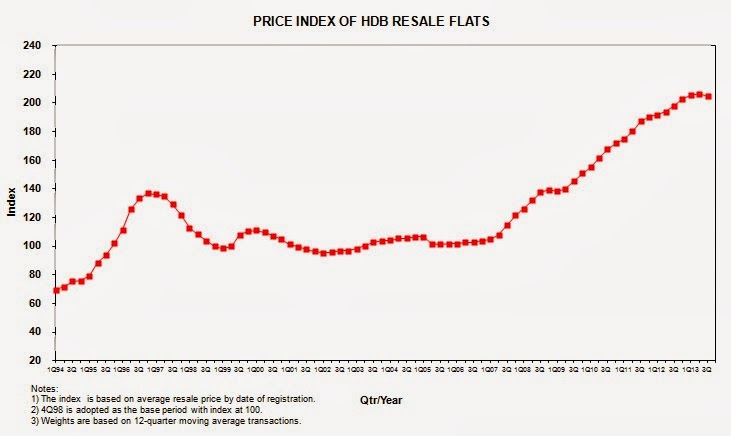
It'll be hard to remember how much HDB prices cost exactly during that time so I'll be using an indicator called HDB resale price index(RSI). This index tracks the average HDB resale prices in Singapore for each Quarter. The RSI was at a high of 136 in 1997 before it crashed to 95 in 1998. After that prices remain stagnant in the 95-110 range for 10 years until 2008.
It's hard to imagine the trend so here's a chart from HDB themselves to show the RSI trend:
As you can see, prices of HDB were up steeply before the crash. In percentage terms, RSI increased almost 100% from 1994 to 1997 before crashing 30% in 1998.
What caused the crash?
Interest rates. I'm referring to home loan interest rates. When interest rates are cheap, people take loan to buy property and when interest rates are expensive, people put on hold their buying of homes. This is one of the factors but there are many other factors too such as available number of properties, number of buyers, government policy for loans and the property market.
Will prices fall again?
Recently, the news on property market have changed. No longer does the news keep saying that property prices are hitting record high. We hearing things like number of housing sales decline, cooling measures slows down rising prices. Analyst are predicting that property prices may fall around the 5% range next year. Will prices fall again? It does seem like it will at least decline marginally or stay stagnant since there's a huge number of supply now and more coming, government has imposed many cooling measures, and interest rates are set to rise soon as US begins tapering.
What does it mean for young couples planning to get their first home now?
If you're getting married and planning to buy a new house, take into consideration that prices may fall. By how much, no one will know exactly.
Here's how you can decrease the impact that may affect you:
1) Take the HDB housing loan.
It's higher than the housing loan offered by banks now but at least it'll save you the worry of rising interest rates. Interest rates on bank loans are definitely lower now but banks will only offer fix rate for a limited amount of time. The longest i've seen is the POSB home loan which fix the rate for 4 years. HDB housing loan is not a fixed rate but it's pegged to 0.1% above the CPF OA interest rates which rarely changes. You don't want to take a bank home loan at 1% now to see it rise to 4% in the future.
2) Buy a house that you can afford comfortably.
Everyone wants to buy a big house. But who thinks of whether you can service the loan for 30 years? Avoid stretching yourself by taking too much debt. You don't want to end up having the difficulty to pay for your house forcing you to sell it prematurely. And if just nice its during the property crash that you are forced to sell, you'll sell it at a loss for sure. Remember if the property market does crash, it'll mean that the economy is not that good and it also means you're very likely to lose your job.
3) Always have an emergency fund ready
No matter what, it is important to put aside some savings for rainy days. In case you lose your high paying job, you still can survive for at least a few more months.
Retrenchment? It'll never happen to me since i'm still young. Don't say it too early. You will never know if it will happen to you. Read: Recession Heroes Ep 4 - Got retrenched at a young age of 23 but still full of passion in life
Conclusion
In conclusion, don't forget that property prices can fall. When it falls, it can stay down for 10 years or more. It has happened before and it can happen again. It may be worse or it may not be worse. Whatever it is, stay safe and don't get caught in it.
This post was sparked off by a conversation with my colleague that his sister just sold her house for a small 30k profit recently. They bought their house at the peak of 1997. That's only 30k profit after 16 years. They had to wait more than 14 years just to breakeven!
Like my articles?
You can Subscribe to SG Young Investment by Email
or follow me on my Facebook page
Related Posts:
1. The dangers of over leveraging on debt
2. How rising interest rate affects the housing loan you pay? [Guest Contribution]
Let me show you the evidence.
HDB resale prices from 1994 to 2013
The year 1996 was the prelude to the Asian financial crisis. I'll skip all the nitty gritty of what exactly happened. If you're interested, you can search for Asian financial crisis and find out more about it. Briefly, it began with the Thai baht currency collapsing and the negative effect spread to the rest of the Asian countries.
It'll be hard to remember how much HDB prices cost exactly during that time so I'll be using an indicator called HDB resale price index(RSI). This index tracks the average HDB resale prices in Singapore for each Quarter. The RSI was at a high of 136 in 1997 before it crashed to 95 in 1998. After that prices remain stagnant in the 95-110 range for 10 years until 2008.
It's hard to imagine the trend so here's a chart from HDB themselves to show the RSI trend:
As you can see, prices of HDB were up steeply before the crash. In percentage terms, RSI increased almost 100% from 1994 to 1997 before crashing 30% in 1998.
What caused the crash?
Interest rates. I'm referring to home loan interest rates. When interest rates are cheap, people take loan to buy property and when interest rates are expensive, people put on hold their buying of homes. This is one of the factors but there are many other factors too such as available number of properties, number of buyers, government policy for loans and the property market.
Will prices fall again?
Recently, the news on property market have changed. No longer does the news keep saying that property prices are hitting record high. We hearing things like number of housing sales decline, cooling measures slows down rising prices. Analyst are predicting that property prices may fall around the 5% range next year. Will prices fall again? It does seem like it will at least decline marginally or stay stagnant since there's a huge number of supply now and more coming, government has imposed many cooling measures, and interest rates are set to rise soon as US begins tapering.
What does it mean for young couples planning to get their first home now?
If you're getting married and planning to buy a new house, take into consideration that prices may fall. By how much, no one will know exactly.
Here's how you can decrease the impact that may affect you:
1) Take the HDB housing loan.
It's higher than the housing loan offered by banks now but at least it'll save you the worry of rising interest rates. Interest rates on bank loans are definitely lower now but banks will only offer fix rate for a limited amount of time. The longest i've seen is the POSB home loan which fix the rate for 4 years. HDB housing loan is not a fixed rate but it's pegged to 0.1% above the CPF OA interest rates which rarely changes. You don't want to take a bank home loan at 1% now to see it rise to 4% in the future.
2) Buy a house that you can afford comfortably.
Everyone wants to buy a big house. But who thinks of whether you can service the loan for 30 years? Avoid stretching yourself by taking too much debt. You don't want to end up having the difficulty to pay for your house forcing you to sell it prematurely. And if just nice its during the property crash that you are forced to sell, you'll sell it at a loss for sure. Remember if the property market does crash, it'll mean that the economy is not that good and it also means you're very likely to lose your job.
3) Always have an emergency fund ready
No matter what, it is important to put aside some savings for rainy days. In case you lose your high paying job, you still can survive for at least a few more months.
Retrenchment? It'll never happen to me since i'm still young. Don't say it too early. You will never know if it will happen to you. Read: Recession Heroes Ep 4 - Got retrenched at a young age of 23 but still full of passion in life
Conclusion
In conclusion, don't forget that property prices can fall. When it falls, it can stay down for 10 years or more. It has happened before and it can happen again. It may be worse or it may not be worse. Whatever it is, stay safe and don't get caught in it.
This post was sparked off by a conversation with my colleague that his sister just sold her house for a small 30k profit recently. They bought their house at the peak of 1997. That's only 30k profit after 16 years. They had to wait more than 14 years just to breakeven!
Like my articles?
You can Subscribe to SG Young Investment by Email
or follow me on my Facebook page
Related Posts:
1. The dangers of over leveraging on debt
2. How rising interest rate affects the housing loan you pay? [Guest Contribution]
Friday, 27 December 2013
Are you a logical or an emotional investor?
In life, there are logical and emotional people. Which one are you? Which kind of personality will be more successful in investing?
What is logical and what is emotional?
Being logical is liken to being rational. Logical people use facts to reason out life. They are known to be reasonable people who work in accordance to rules of logic. They are most likely good in analysis, computer coding and IT stuffs.
Being emotional on the other hand is liken to being irrational. Emotional people make decisions base on their feelings or gut feel. They are sometimes known as unreasonable people who does not work in accordance to logic.

The discussion on being logical or emotional
Over the Christmas holidays, me and my relatives were discussing on the difference of being logical or emotional. My uncles were saying that my cousin was too logical and he could not believe anything if there were no facts. He needs facts to believe that something is reasonable. One of my uncles then went on to comment that we can't be too logical when finding our life partner. Many of us will have a list of characteristics when looking for a partner of the opposite sex. However, sometimes it is quite impossible to find our "perfect" someone. If we're too logical and strictly follow a guideline, we may never find that someone. Sometimes, emotions are what brings two people together. My uncle went on to explain that it is the same with starting a business. A logical person will find that starting a business is too risky. All facts will point to the impossibility of starting a business. To a logical person, it is always too risky to start a business.
Now I'm not telling you that being logical is bad. It is only bad if you're overly logical. It is also bad if you're overly emotional. We don't want to be on the extremes of each side. The key is to find a balance between the both. In investing, we often hear that we can't be too emotional. Being too emotional will result in us making all the wrong investment decisions. On the other hand, we can't be too logical also. Every investor will know that we cannot know whether a stock is at its bottom or at its peak. When a stock goes up, it can go higher and when a stock goes down, it can go even lower. If you're too logical and try to predict the perfect entry point, then you will never find one at all. It's the same as finding a perfect partner which is virtually none existence.
Always be prepared that nothing is perfect
Therefore, to be a successful investor, one needs to know that there are no perfect entry points. We need to acknowledge this imperfection and work around it. When you buy a stock, be prepared for prices to go down so you can buy more. This means you should put aside extra capital at every instance. This is liken to an opportunity fund where you deploy in when the market declines. This imperfection may exist throughout your investing journey no matter how much experience you have. You need to prepare yourself for it. It's the same in your marriage or relationships. You know your partner is imperfect and you acknowledge that. You work around it by knowing the imperfection and prepare for it. How you prepare for it is up to individuals. However, relationships are more complicated. Sometimes you just have to accept the imperfections and live through it.
In investing, we do our part by researching on the company, analysing its financial statements, calculating its intrinsic value and determine the fair value to enter. As long as the company's fundamentals remain strong, an investor continues buying at or below the fair value. In the long term, gains are realised in the form of dividends and capital appreciation.
When you first started investing, it is liken to starting a business. An overly logical person will find investing too risky and never get in while an overly emotional person will jump into the market ignoring risk and get themselves burnt. If you manage to find the balance between the both, you will be on your way to being a successful investor.
Like my articles?
You can Subscribe to SG Young Investment by Email
or follow me on my Facebook page
What is logical and what is emotional?
Being logical is liken to being rational. Logical people use facts to reason out life. They are known to be reasonable people who work in accordance to rules of logic. They are most likely good in analysis, computer coding and IT stuffs.
Being emotional on the other hand is liken to being irrational. Emotional people make decisions base on their feelings or gut feel. They are sometimes known as unreasonable people who does not work in accordance to logic.
The discussion on being logical or emotional
Over the Christmas holidays, me and my relatives were discussing on the difference of being logical or emotional. My uncles were saying that my cousin was too logical and he could not believe anything if there were no facts. He needs facts to believe that something is reasonable. One of my uncles then went on to comment that we can't be too logical when finding our life partner. Many of us will have a list of characteristics when looking for a partner of the opposite sex. However, sometimes it is quite impossible to find our "perfect" someone. If we're too logical and strictly follow a guideline, we may never find that someone. Sometimes, emotions are what brings two people together. My uncle went on to explain that it is the same with starting a business. A logical person will find that starting a business is too risky. All facts will point to the impossibility of starting a business. To a logical person, it is always too risky to start a business.
Now I'm not telling you that being logical is bad. It is only bad if you're overly logical. It is also bad if you're overly emotional. We don't want to be on the extremes of each side. The key is to find a balance between the both. In investing, we often hear that we can't be too emotional. Being too emotional will result in us making all the wrong investment decisions. On the other hand, we can't be too logical also. Every investor will know that we cannot know whether a stock is at its bottom or at its peak. When a stock goes up, it can go higher and when a stock goes down, it can go even lower. If you're too logical and try to predict the perfect entry point, then you will never find one at all. It's the same as finding a perfect partner which is virtually none existence.
Always be prepared that nothing is perfect
Therefore, to be a successful investor, one needs to know that there are no perfect entry points. We need to acknowledge this imperfection and work around it. When you buy a stock, be prepared for prices to go down so you can buy more. This means you should put aside extra capital at every instance. This is liken to an opportunity fund where you deploy in when the market declines. This imperfection may exist throughout your investing journey no matter how much experience you have. You need to prepare yourself for it. It's the same in your marriage or relationships. You know your partner is imperfect and you acknowledge that. You work around it by knowing the imperfection and prepare for it. How you prepare for it is up to individuals. However, relationships are more complicated. Sometimes you just have to accept the imperfections and live through it.
In investing, we do our part by researching on the company, analysing its financial statements, calculating its intrinsic value and determine the fair value to enter. As long as the company's fundamentals remain strong, an investor continues buying at or below the fair value. In the long term, gains are realised in the form of dividends and capital appreciation.
When you first started investing, it is liken to starting a business. An overly logical person will find investing too risky and never get in while an overly emotional person will jump into the market ignoring risk and get themselves burnt. If you manage to find the balance between the both, you will be on your way to being a successful investor.
Like my articles?
You can Subscribe to SG Young Investment by Email
or follow me on my Facebook page
Tuesday, 24 December 2013
A success story - Olivia Lum, the person who created water for Singapore
According to Forbes, Olivia is Singapore's 27th richest person with an estimated net worth of $460 Million. She was originally from Malaysia, living in a small town of Kampur in Perak, Malaysia. In her younger days, she would hear people quarrelling because of money, especially husbands and wives. The village was poor and Olivia was living in a leaky shack without running water with her grandmother. She thought to herself that she cannot live in such a poverty stricken place and she must get out of the poverty cycle one day...... She came to Singapore in search for better education at the tender age of 16. This was the life changing event for her.
An interesting fact is Hyflux's first project in Singapore was to cater clean drinking water for birds. Yes, you did not read wrongly, it was for birds. The project was to recycle waste water into pure drinking water for birds at Jurong Bird Park. The company has thus come far to create Singapore's first own drinking water called NEWater.
They have recently opened their new innovation centre which i've been there before. The new centre is really nice with modern architecture. It's a symbol of their success till date. They have innovated to create water from air. This new product is called Hyflux dragon fly which produces clean water from air. There is no requirement to fix the machine to a water pipe like our regular water cooler. This produces drinking water for anyone anywhere even without a water source.
The video starts with Olivia showing us her childhood living environment to her former schools and interviews with ex teachers, principals and so on.
Watch the video below for her whole story and exclusive interview with Olivia herself:
Like my articles?
You can Subscribe to SG Young Investment by Email
or follow me on my Facebook page
You can Subscribe to SG Young Investment by Email
or follow me on my Facebook page
Sunday, 22 December 2013
Reflections for 2013
In a few days time, 2013 will come to a close. It is time to reflect on this year before setting resolutions for next year. So here goes.
Finances
I've finished paying the school fees for my part time degree course. It has been tough juggling with work and school but i'm glad i've survived another year. Total school fees paid was about $15000. After paying for school fees, i'm still able to have savings from my salary which is a good thing. Without a huge chunk of my money going towards paying for school fees from now onwards, my savings rate will increase too. This lets me have more money to buy stocks.
Salary Increment and Bonus
The work year has been good. I've received a salary increment of more than 10% and an above average bonus in total of about 4.5 months. This in my opinion is already very good as i'm only a junior executive now in a diploma level job. In case you didn't know, diploma holders on average are not paid highly in Singapore. An average person receives about $2200 per month with 2-3 years of work experience. This is also one of the reason why i continued to further my studies to get a degree. It is simply too little to live comfortably in Singapore if you want to start a family.
Family Life
Talking about family, i'm still single and living a carefree life. However, i'm already preparing myself in case i would get married one day. Wedding, honeymoon, getting a house are all major expenses which need to be prepared for. Good that other financial bloggers share their expenditures of their life after marriage. This gives me a rough gauge of how much is actually needed. Thanks to you guys! (You know who you are.)
Investments
The Singapore stock market has been flat this year with a rally in the first few months of the year and a drop in later half of the year. I've added in more stocks which i feel is undervalued and has the potential for growth.
Some of the counters are Marco Polo Marine and HPH trust for shipping and exports related growth. Croesus retail trust for Japanese economic growth which i believe will happen as Japan embark on its own QE program. Yongnam for investment into the construction sector which will benefit from the various projects such as the new marina bay CBD which they have recently clinched the contract to fabricate and construct structural steelwork.
Miscellaneous
I've managed to clear my annual IPPT for the second time this year. For those who do not know what IPPT is, it is actually an annual fitness test that is required for every Singaporean National Service Men. For me, i'll still have to serve the army for the next 7 years. Next year will be my 3rd reservist.
This is also a year where i started my blog in June. Blogging has enabled me to know other financial bloggers and also the readers who have been reading what i write. Thanks to all of you who have supported my blog which motivates me to continue writing more articles. My Facebook page is reaching 100 Likes soon and my blog will also reach 100000 views soon. This is a small humble beginning of my journey. I hope to provide all of you with more quality articles as we continue this journey. Feel free to comment or email me if you got any topic suggestions or request.
Lastly, here's wishing all of you a Merry Christmas and a Happy new year. Let's celebrate and finish this year with a grateful and happy spirit.
Like my articles?
You can Subscribe to SG Young Investment by Email
or follow me on my Facebook page
Finances
I've finished paying the school fees for my part time degree course. It has been tough juggling with work and school but i'm glad i've survived another year. Total school fees paid was about $15000. After paying for school fees, i'm still able to have savings from my salary which is a good thing. Without a huge chunk of my money going towards paying for school fees from now onwards, my savings rate will increase too. This lets me have more money to buy stocks.
Salary Increment and Bonus
The work year has been good. I've received a salary increment of more than 10% and an above average bonus in total of about 4.5 months. This in my opinion is already very good as i'm only a junior executive now in a diploma level job. In case you didn't know, diploma holders on average are not paid highly in Singapore. An average person receives about $2200 per month with 2-3 years of work experience. This is also one of the reason why i continued to further my studies to get a degree. It is simply too little to live comfortably in Singapore if you want to start a family.
Family Life
Talking about family, i'm still single and living a carefree life. However, i'm already preparing myself in case i would get married one day. Wedding, honeymoon, getting a house are all major expenses which need to be prepared for. Good that other financial bloggers share their expenditures of their life after marriage. This gives me a rough gauge of how much is actually needed. Thanks to you guys! (You know who you are.)
Investments
The Singapore stock market has been flat this year with a rally in the first few months of the year and a drop in later half of the year. I've added in more stocks which i feel is undervalued and has the potential for growth.
Some of the counters are Marco Polo Marine and HPH trust for shipping and exports related growth. Croesus retail trust for Japanese economic growth which i believe will happen as Japan embark on its own QE program. Yongnam for investment into the construction sector which will benefit from the various projects such as the new marina bay CBD which they have recently clinched the contract to fabricate and construct structural steelwork.
Miscellaneous
I've managed to clear my annual IPPT for the second time this year. For those who do not know what IPPT is, it is actually an annual fitness test that is required for every Singaporean National Service Men. For me, i'll still have to serve the army for the next 7 years. Next year will be my 3rd reservist.
This is also a year where i started my blog in June. Blogging has enabled me to know other financial bloggers and also the readers who have been reading what i write. Thanks to all of you who have supported my blog which motivates me to continue writing more articles. My Facebook page is reaching 100 Likes soon and my blog will also reach 100000 views soon. This is a small humble beginning of my journey. I hope to provide all of you with more quality articles as we continue this journey. Feel free to comment or email me if you got any topic suggestions or request.
Lastly, here's wishing all of you a Merry Christmas and a Happy new year. Let's celebrate and finish this year with a grateful and happy spirit.
Like my articles?
You can Subscribe to SG Young Investment by Email
or follow me on my Facebook page
Subscribe to:
Posts (Atom)


